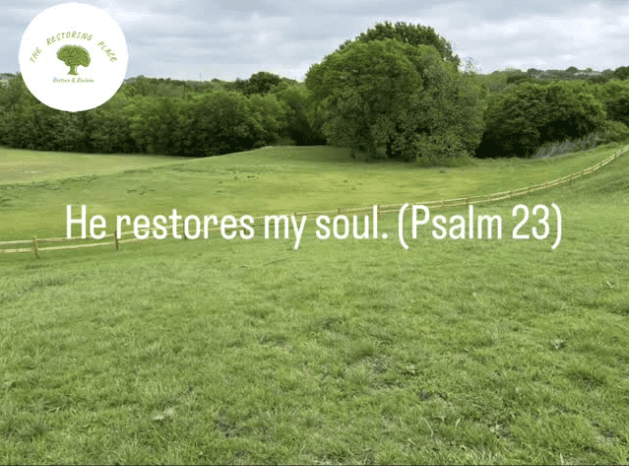
He Restores My Soul . ( Psalm 23)
Do you find it difficult to turn off your mind lately? Even when the day is over, your thoughts keep going—replaying conversations, planning what’s next, and carrying things that haven’t even happened yet. You may lie down to rest, but your mind stays on, leaving you feeling restless.
If that sounds familiar, here are a few ways to help you feel grounded again.

1. Get out of your head — Ground your body
Anxiety is not only in your mind; it is also experienced in your body. That’s why trying to “think your way out” of anxiety often doesn’t work. Instead, begin by gently shifting your attention out of your thoughts and into your body.
This can look like simple movement—taking a walk, exercising without distractions, or just stepping outside and breathing slowly. If that’s not possible, you can also try a guided mental picture.
One scene that many find calming comes from Psalm 23:
“He makes me lie down in green pastures,
He leads me beside still waters;
He restores my soul.”
Take a moment and imagine this scene.
A wide, open field—lush green, steady, and quiet.
Still water nearby—not rushing, not loud, just calm.
The air is gentle. There is space to breathe.
Now place yourself there—not as an observer, but as someone being led into that place.
You are not creating this environment.
You are being guided into it.
As you lie down, notice what you see—the sky above, trees in the distance.
Notice what you hear—the soft movement of water, perhaps birds nearby.
Feel what supports you—the ground beneath you, steady and present.
Notice the air on your skin, the rhythm of your breathing.
Perhaps you can even imagine the scent of fresh grass.
There is nothing you need to fix at this moment.
Nothing you need to solve.
Just space.
Stay here for a few breaths and allow your body and mind to gradually settle.

2. Be mindful of your limits — set healthy boundaries
I often use a simple “mug” analogy.
Imagine a mug—no matter how large or strong it is, it still has a limit. Once it is full, anything more will overflow and create a mess.
In the same way, your mind and body have limits. When too much is poured in—responsibilities, expectations, information—it can overflow emotionally, often showing up as anxiety.
Learning to notice your limits and protect what comes into your “mug” is essential. This may mean saying no to certain commitments—even good ones—so that you can say yes to what truly matters.
Sustainable peace often comes not from doing more, but from holding appropriate boundaries.

3. Process what is stored beneath the surface
Managing anxiety in the moment and setting boundaries are important, there is another piece that is often overlooked.
Sometimes, anxiety is not only about what is happening now—it is also connected to things stored much deeper.
Past experiences such as unresolved grief, childhood neglect, or painful memories can quietly take up space. Over time, they reduce your capacity to handle present stress, making your “mug” feel full more quickly.
Facing these areas can feel intimidating. It may even feel uncomfortable at first. But processing them can lead to significant long-term relief.
Healing does not always require retelling every detail of painful experiences. There are ways to process these memories at a deeper, bodily level, allowing them to lose their intensity over time.
As this happens, many people notice they feel lighter, less reactive, and more able to handle everyday stress.

4. Come to the One who restores
Finally, anxiety is not only a mental or emotional experience—it also touches something deeper in the soul.
Psalm 23 reminds us:
“He restores my soul.”
There is a kind of rest that cannot be produced by effort alone.
When we come to God regularly—bringing our thoughts, our burdens, and our restlessness to Him—something begins to shift. It becomes a place of reset for the mind, the body, and the spirit.
You do not have to carry everything on your own.
There is a Shepherd who leads, who provides, and who restores.